Data Room m&a: Quick Outlook
Mergers and acquisitions involve some of the most sensitive business information a company will ever share. Financial records, intellectual property, customer contracts, legal documents, employee information, and strategic plans all need to be exchanged securely between buyers, sellers, advisors, and investors. This is where data room m&a becomes an essential part of every successful transaction.
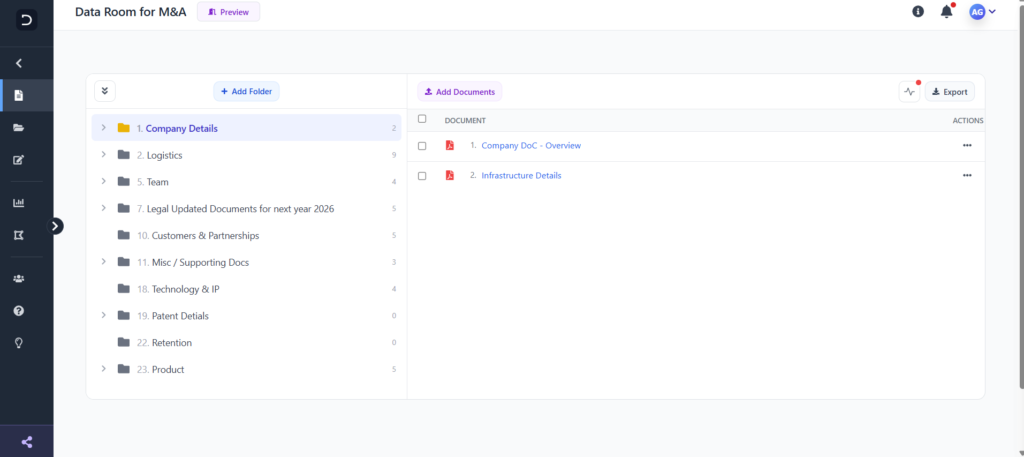
Modern businesses have moved away from physical document repositories and now rely on secure digital platforms that simplify collaboration while protecting confidential information. Whether you’re preparing for an acquisition, selling your company, raising capital, or conducting due diligence, having a well-organized virtual data room can significantly improve the speed and success of the transaction.
In this comprehensive guide, you’ll learn everything about M&A data rooms, why they’re important, how they support due diligence, what documents should be included, and the best practices that help companies close deals faster while maintaining complete control over confidential information.
What Is an M&A Data Room?
A data room m&a is a secure digital environment used to store, organize, and share confidential business documents during mergers, acquisitions, investments, strategic partnerships, and corporate transactions.
Unlike ordinary cloud storage solutions, virtual data rooms provide advanced security features designed specifically for high-value transactions. These include granular access permissions, document tracking, watermarking, audit logs, encrypted storage, dynamic permissions, and secure sharing.
The primary objective is simple: allow authorized stakeholders to review confidential information while preventing unauthorized access, downloads, or leaks.
Organizations ranging from startups to multinational enterprises rely on Data rooms because they provide a structured, secure, and efficient way to collaborate throughout complex transactions.
Data Rooms Meaning
Many people ask about data rooms meaning before beginning fundraising or acquisition discussions.
A data room is a secure repository where confidential company information is stored for review by authorized individuals. Traditionally, these were physical rooms containing filing cabinets and printed documents that buyers visited in person.
Today, businesses use cloud-based virtual data rooms that eliminate geographical limitations while offering significantly stronger security controls and collaboration capabilities.
Instead of sending dozens of email attachments, companies simply grant controlled access to relevant stakeholders while maintaining complete visibility over document activity.
Why M&A Transactions Need Secure Data Rooms
Every acquisition involves multiple parties reviewing thousands of confidential files. Buyers want transparency, while sellers need to protect proprietary information until the transaction is complete.
Without a centralized platform, businesses often struggle with scattered email attachments, outdated document versions, permission issues, and limited visibility into buyer engagement.
A professional virtual data room solves these challenges by creating one secure source of truth where every document remains organized, searchable, and protected throughout the transaction lifecycle.
Additionally, companies gain valuable insights into document engagement, allowing advisors to understand which files receive the most attention from potential buyers.
Evolution from Physical Data Rooms to Virtual Platforms
Years ago, acquisitions required physical document rooms where buyers traveled to review printed records.
This process was expensive, time-consuming, and difficult to manage. Multiple buyers could not easily review documents simultaneously, updates required reprinting files, and access scheduling slowed the overall transaction.
Today’s virtual solutions allow secure access from anywhere in the world while maintaining enterprise-grade encryption, permission management, detailed audit trails, and instant document updates.
As businesses become increasingly global, digital collaboration has become the standard for modern transactions.
Key Benefits of Using Data Room M&A
Businesses gain numerous operational and security advantages by implementing data room m&a during acquisitions and corporate transactions.
Some of the biggest benefits include:
- Secure document sharing
- Faster due diligence
- Better document organization
- Real-time collaboration
- Detailed audit trails
- Controlled user permissions
- Version management
- Reduced administrative work
- Improved investor confidence
- Faster transaction completion
These capabilities reduce risk while improving communication between buyers, sellers, legal advisors, accountants, consultants, and investors.
How Virtual Data Rooms Support Due Diligence
Due diligence is one of the most critical stages of any transaction.
Potential buyers carefully evaluate every aspect of a company before committing to an acquisition. They verify financial health, legal compliance, operational stability, intellectual property, tax obligations, customer relationships, technology infrastructure, and future growth opportunities.
A structured virtual data room keeps every document organized into logical folders, making reviews significantly faster.
Instead of requesting files individually over email, reviewers access everything through one secure platform with clearly organized categories.
This approach dramatically reduces delays while ensuring every stakeholder works from the latest version of each document.
Data Room Due Diligence Checklist
An organized data room due diligence checklist ensures no important document is overlooked during the review process.
Typical categories include:
| Category | Common Documents |
|---|---|
| Corporate Information | Certificate of incorporation, bylaws, shareholder records |
| Financial Records | Balance sheets, income statements, cash flow reports |
| Legal Documents | Contracts, litigation records, licenses |
| Human Resources | Employee agreements, benefits, organization charts |
| Intellectual Property | Patents, trademarks, copyrights |
| Technology | Software architecture, security policies, infrastructure |
| Sales & Marketing | Customer contracts, pricing, marketing materials |
| Operations | Vendor agreements, supply chain documentation |
| Compliance | Regulatory filings, certifications |
| Tax | Tax returns, audits, filings |
Maintaining a complete checklist reduces buyer questions and accelerates the overall due diligence timeline.
What Should Be in a Data Room?
Many founders ask what should be in a data room before approaching investors or acquisition partners.
The answer depends on the transaction, but most organizations should include:
- Company overview
- Corporate structure
- Cap table
- Financial statements
- Bank information
- Customer contracts
- Vendor agreements
- Intellectual property
- Product documentation
- Sales pipeline
- Marketing assets
- HR policies
- Insurance documents
- Compliance certifications
- Tax filings
- Board meeting minutes
- Business plans
- Forecasts
- Technology documentation
- Risk assessments
Well-organized documentation increases buyer confidence while reducing repetitive information requests.
Essential Security Features
Security remains the most important factor when selecting a virtual data room.
Leading platforms typically provide:
- End-to-end encryption
- Multi-factor authentication
- Role-based permissions
- Dynamic watermarking
- Activity logs
- Document expiration
- IP restrictions
- Secure viewing modes
- Download controls
- Remote access revocation
These capabilities ensure confidential business information remains protected throughout negotiations.
Organizing Documents for Faster Reviews
Poor organization creates unnecessary delays.
Instead of uploading random folders, businesses should create a logical hierarchy with consistent naming conventions.
Major sections often include corporate documents, finance, legal, HR, operations, technology, intellectual property, compliance, and customer information.
Each folder should contain only current documents while outdated versions are archived appropriately.
Consistent organization allows reviewers to quickly locate information without repeatedly requesting assistance.
Role-Based Permissions Improve Security
Not every participant requires access to every document.
Modern virtual data rooms allow administrators to assign permissions based on roles.
Executives may receive complete access while legal advisors only view legal documents. Financial advisors can review accounting information, and potential buyers may receive progressively expanded access as negotiations advance.
Granular permission controls reduce unnecessary exposure of confidential information.
Data Room for Investors
A professional data room for investors plays a major role during fundraising.
Angel investors, venture capital firms, private equity groups, and institutional investors often request access before making investment decisions.
Instead of exchanging dozens of emails, founders can organize financial reports, pitch materials, customer metrics, market analysis, legal documents, and growth plans within one secure workspace.
This creates a professional impression while simplifying communication throughout the fundraising process.
Choosing the Right Data Room Software
Selecting reliable data room software requires evaluating multiple factors beyond pricing alone.
Important considerations include:
- Security certifications
- Ease of use
- Permission controls
- Audit reporting
- Search functionality
- Upload speed
- Collaboration tools
- File preview support
- Mobile accessibility
- Customer support
- Scalability
- Integration capabilities
The right platform should simplify transactions rather than introducing unnecessary complexity.
Why Businesses Compare Data Room Providers
There are many data room providers available, each offering different pricing models, security features, collaboration capabilities, and storage limits.
Businesses should compare providers based on transaction size, expected number of users, compliance requirements, and long-term scalability rather than selecting solely based on subscription cost.
A solution designed specifically for corporate transactions generally provides better security and document management than generic file-sharing services.
Common Mistakes to Avoid
Many organizations unintentionally slow transactions through avoidable mistakes.
Some of the most common include:
- Uploading incomplete documents
- Poor folder organization
- Outdated financial statements
- Missing legal agreements
- Excessive user permissions
- Weak naming conventions
- Delayed document updates
- Limited access monitoring
- Sharing sensitive files outside the platform
Avoiding these issues helps maintain momentum throughout negotiations.
Best Practices for Managing an M&A Data Room
Successful transactions depend on disciplined document management.
Best practices include regularly reviewing permissions, maintaining updated financial records, organizing documents consistently, monitoring user activity, removing duplicate files, tracking document versions, and responding quickly to buyer requests.
Companies should also assign a dedicated administrator responsible for maintaining document quality and ensuring every stakeholder has appropriate access throughout the process.
These practices improve efficiency while minimizing operational risks.
Future Trends in Virtual Data Rooms
The future of secure document management continues to evolve.
Artificial intelligence is improving document classification, search capabilities, automated redaction, and risk identification.
Analytics are becoming more sophisticated, helping organizations understand buyer engagement and identify highly reviewed documents.
Automation is also reducing administrative effort by simplifying permission management, notifications, document indexing, and workflow approvals.
As cybersecurity threats continue growing, virtual data rooms will likely introduce even stronger identity verification and compliance capabilities.
Conclusion
Every successful acquisition depends on secure information sharing, efficient collaboration, and organized documentation. A well-managed data room m&a enables businesses to streamline due diligence, reduce transaction delays, protect confidential information, and improve buyer confidence throughout every stage of the deal.
Whether your company is preparing for fundraising, attracting investors, selling the business, or acquiring another organization, investing time in building a structured virtual data room pays significant dividends. Organized documentation, strong security, detailed audit trails, and professional collaboration tools create a smoother experience for everyone involved while increasing the likelihood of a successful transaction.
As corporate transactions continue becoming more digital, organizations that embrace secure virtual data rooms will remain better positioned to manage complex deals efficiently, protect sensitive information, and build trust with investors, advisors, and acquisition partners.
FAQ
What is a virtual data room used for in mergers and acquisitions?
A virtual data room is used to securely share confidential business information between buyers, sellers, advisors, and legal teams during acquisitions, mergers, and corporate transactions. It centralizes documentation while maintaining strict access controls.
How is data room m&a different from regular cloud storage?
Unlike standard cloud storage, virtual data rooms include advanced security features such as audit trails, watermarking, role-based permissions, document expiration, encrypted access, and detailed user activity tracking designed specifically for high-value transactions.
Why is a data room due diligence checklist important?
A checklist ensures every required document is available before buyers begin reviewing the business. This reduces delays, minimizes repeated requests, and helps maintain a smooth due diligence process.
Who should have access to a data room for investors?
Access should be limited to authorized investors, founders, advisors, accountants, and legal professionals based on their role. Permission settings should follow the principle of least privilege to protect confidential information.
What should be in a data room before fundraising?
A fundraising data room should include financial statements, the cap table, incorporation documents, customer metrics, business plans, intellectual property records, contracts, compliance documents, product information, and growth projections.
Can small businesses benefit from virtual data rooms?
Yes. Small businesses, startups, and growing companies benefit from improved organization, stronger security, easier collaboration with investors, and a more professional fundraising or acquisition process.
How secure is modern data room software?
Leading platforms use enterprise-grade encryption, multi-factor authentication, access controls, audit logs, watermarking, and secure hosting environments to protect highly confidential business information.
How do businesses choose among different data room providers?
Organizations should compare providers based on security certifications, usability, pricing, compliance support, scalability, customer service, reporting capabilities, integrations, and document management features rather than choosing based solely on cost.