iDeals: VDR deep dive & feature highlights
When startups, investment bankers, and dealmakers think about running a successful capital raise, choosing the right VDR becomes a critical decision. Many teams start by evaluating iDeals, one of the most popular virtual data room providers, but quickly realize there are limitations that slow down their fundraising process. In this guide, we will dive deep into an honest iDeals review, compare it against DeelTrix, and explore which platform truly delivers a better experience for M&A, investor outreach, and duedilligence workflows.
Compare Ideals Feature with DeelTrix to see which fits your next project
| Features | iDeals | DeelTrix |
|---|---|---|
| Advance sharing controls | Yes | Yes |
| Dynamic watermarking | Yes | Yes |
| Page level analytics | No | Yes |
| Document expiry | Yes | Yes |
| Analytics | Yes | Yes |
| User Groups | Yes (on higher tiers) | Yes |
| NDA gating & exports | No | Yes |
| Audit trails export | No | Yes |
| Team collaboration | Yes | Yes |
| Q&A Management | Yes | Yes |
| Unlimited Data rooms | No | Yes |
| Unlimited Document visitors | No | Yes |
| Notes & internal comments | Yes | Yes |
| Custom branding | Yes | Yes |
| Regional Aware Document Selection per room (Americas, Europe, Asia Pacific) | No | Yes |
| ISO 27001 Certified | Yes | Yes |
The Rise of iDeals in Fundraising and Why DeelTrix Is a Strong Alternative

Over the last decade, iDeals has established itself as a recognized virtual data room solution for companies handling confidential transactions. Fundraising teams can use iDeals to organize investor documents, control access, and share sensitive information during due diligence. For early-stage companies, these capabilities can provide a structured alternative to sending financial models, pitch decks, legal documents, and other confidential files through email.
However, fundraising has become increasingly data-driven. Investors want quick access to information, while founders and fundraising teams want to understand how prospective investors are engaging with their materials. This is where teams comparing iDeals with modern VDR platforms may look for greater flexibility.
A VDR iDeals workflow can provide the foundation for secure document sharing, but DeelTrix expands the workflow with engagement analytics, Data Room Groups, granular permissions, notifications, Q&A management, and collaboration features.
Why Fundraising Teams Need More Than Secure Storage
A modern fundraising data room should help teams manage three important areas:
- Information protection — Ensure confidential documents are available only to authorized investors.
- Investor engagement — Understand how prospective investors interact with shared materials.
- Deal administration — Make it easier to manage permissions, questions, updates, and multiple investor groups.
This is where DeelTrix provides a compelling alternative to iDeals.
| DeelTrix Feature | Fundraising Benefit |
|---|---|
| View Only, Print & Download Controls | Decide whether investors can view, print, or download specific documents. |
| Print With Watermark | Protect printed copies of sensitive financial or legal documents with watermarking. |
| Granular Folder/Document Access | Give each investor access only to the information appropriate for their stage. |
| Analytics | Understand investor engagement with shared materials. |
| Notify | Send investor groups updates with admin notes and references to specific documents. |
| Custom Watermarking | Reinforce confidentiality across investor materials. |
| NDA Gating | Require confidentiality acknowledgment before protected information is accessed. |
| Audit Export | Maintain transaction activity records for reporting and oversight. |
| Team Collaboration | Allow internal fundraising teams to coordinate around documents and investor activity. |
| Storage Location Choice | Select North America, APAC, or Europe based on applicable data residency requirements. |
| Data Room Groups | Organize investors according to fundraising stage or organization. |
| Q&A Management | Keep investor questions and responses organized in one place. |
1. Control What Every Investor Can Access
During fundraising, not every investor should necessarily receive the same information.
For example:
- Initial Interest: Pitch deck and company overview
- Active Discussion: Pitch deck, market information, and financial summary
- Due Diligence: Financial models, contracts, customer information, and legal documents
- Lead Investor: Detailed transaction and company information
DeelTrix Data Room Groups allow administrators to organize investors according to these stages and manage access more efficiently than configuring every participant individually.
This can be particularly useful for teams evaluating iDeals alternatives.
2. Give Investors Flexible Document Permissions
DeelTrix provides View Only, Print, and Download controls.
A founder could allow an investor to view a sensitive financial model without downloading it. A legal advisor could be permitted to print a contract with watermarking, while an approved investor could download selected documents for offline analysis.
This gives fundraising teams greater control over how information is consumed.
3. Understand Investor Engagement With Analytics
One major advantage of DeelTrix is its focus on analytics.
Instead of simply knowing that an investor received a pitch deck, fundraising teams can use analytics to understand document engagement.
For example, a founder might discover that:
- Investor A repeatedly reviews the financial model.
- Investor B focuses on the market presentation.
- Investor C has barely opened the shared materials.
These signals can help the fundraising team prioritize follow-up conversations.
This engagement-focused approach can be a valuable differentiator for organizations comparing VDR iDeals with modern alternatives.
4. Group Analytics Makes Investor Comparison Easier
DeelTrix takes analytics further through Group Analytics.
Suppose a startup has 30 investors divided into three groups:
| Investor Group | Number of Investors | Purpose |
|---|---|---|
| Initial Interest | 15 | Early-stage evaluation |
| Active Discussions | 10 | Investors in serious conversations |
| Due Diligence | 5 | Detailed investment review |
The fundraising team can compare activity across these groups and monitor how engagement changes as investors progress through the process.
This can provide a clearer view of fundraising momentum without requiring administrators to manually compile individual activity.
5. Communicate Updates Faster
Fundraising documents often change. A company may update its financial model, revise its pitch deck, or add a new customer document.
DeelTrix Notify allows administrators to broadcast updates to selected investor groups with admin notes.
For example:
Updated Financial Model: We have uploaded the revised FY2026 forecast. Please review the updated revenue assumptions.
The administrator can reference the specific document, helping investors immediately identify what requires attention.
6. Keep Investor Questions Organized
Investor diligence can generate questions about revenue, customers, market size, contracts, hiring, technology, and financial projections.
DeelTrix Q&A Management keeps these questions and responses organized within the fundraising environment.
This reduces dependence on scattered email conversations and gives internal teams a clearer record of investor requests.
Why DeelTrix Is a Strong Alternative
iDeals can provide a structured environment for secure fundraising document sharing, but modern fundraising teams may require more visibility and flexibility.
DeelTrix combines:
- Granular access
- Investor Groups
- Group Analytics
- Document Analytics
- View/Print/Download controls
- Watermarked printing
- NDA gating
- Q&A Management
- Notify
- Audit Export
- Team Collaboration
- Regional storage options
For businesses comparing iDeals, the key difference is the broader emphasis on investor engagement and transaction workflow management.
Rather than using a VDR only to store fundraising documents, DeelTrix helps teams control information, organize investors, monitor engagement, communicate updates, and manage diligence from one environment.
For startups, advisors, and fundraising teams looking beyond a traditional VDR iDeals experience, DeelTrix provides a modern alternative designed around the way fundraising teams operate today.
Why M&A and Due Diligence Teams Start Looking Beyond iDeals

M&A and due diligence have become increasingly fast-moving processes. Buyers, sellers, investment banks, advisors, legal teams, and investors may need to review thousands of documents while working against strict transaction deadlines. In this environment, simply providing secure document access is no longer enough. Deal teams also need visibility into stakeholder activity, efficient permission management, faster communication, and tools that help them understand transaction progress.
iDeals provides a structured environment for confidential document sharing, but modern deal teams may want a more connected workflow. Instead of relying primarily on traditional activity records, they increasingly expect visual analytics, group-level engagement insights, flexible document permissions, and streamlined collaboration.
This is where DeelTrix offers a compelling alternative.
1. Speed Matters During Due Diligence
In an M&A transaction, delays can affect negotiations, buyer confidence, and closing timelines. Advisors may need to respond quickly when a buyer requests additional documents or raises questions about financial or legal information.
A modern data room should therefore help teams:
- Organize documents quickly.
- Control access efficiently.
- Monitor stakeholder engagement.
- Respond to questions.
- Communicate document updates.
- Identify areas requiring attention.
DeelTrix brings these workflows together so teams can spend less time on repetitive administration and more time managing the transaction.
2. Move Beyond Basic Activity Logs
Traditional audit information can tell administrators that a user accessed a document. However, deal teams often want a broader understanding of what is happening inside the transaction.
DeelTrix Analytics and Group Analytics can provide a more visual way to understand engagement.
For example, an M&A advisor managing three potential buyers can create separate groups:
| Buyer Group | Activity Example | Potential Insight |
|---|---|---|
| Buyer A | Frequently reviews financial models | Strong financial diligence activity |
| Buyer B | Focuses on commercial contracts | Greater commercial focus |
| Buyer C | Limited document activity | May require follow-up |
These insights do not determine buyer intent by themselves, but they provide additional context that can help advisors prioritize conversations.
3. Group Analytics Makes Deal Progress Easier to Understand
One of DeelTrix’s useful capabilities is Group Analytics.
Instead of reviewing dozens of users individually, administrators can compare activity across stakeholder groups. This is especially valuable in competitive M&A processes where multiple buyers may be reviewing the same information simultaneously.
Teams can examine:
- Document engagement
- Group activity
- Download behavior
- Frequently accessed materials
- Changes in engagement over time
- Relative activity between buyers
This creates a clearer picture of how different stakeholders are progressing through diligence.
4. Granular Permissions Reduce Administrative Friction
Due diligence involves highly sensitive information. Buyers may require access to financial statements, while legal advisors may only need contracts and corporate records.
DeelTrix provides granular folder and document-level permissions, allowing administrators to create different access structures for different participants.
The platform also supports:
- View Only
- Print with Watermark
- Download
This allows administrators to match document permissions with the sensitivity of the information.
5. Groups Make Changing Access Easier
M&A transactions evolve. A buyer may initially receive limited access and later progress into detailed due diligence.
Instead of manually changing permissions for every participant, DeelTrix Data Room Groups allow administrators to organize users according to transaction stage or role.
For example:
Initial Review → Active Diligence → Advanced Diligence
Users can be moved between appropriate groups as their requirements change.
This can significantly simplify administration when a transaction involves dozens of participants.
6. Faster Communication With Notify
Document updates are common during due diligence. A seller may replace a financial model, upload a new contract, or add an important operational document.
DeelTrix Notify allows administrators to broadcast updates to selected groups and include an admin note.
For example:
Updated Financial Model: The FY2026 forecast has been revised. Please review the updated revenue assumptions in the latest financial model.
The administrator can reference the relevant document, helping buyers immediately understand what has changed.
7. Q&A Keeps Due Diligence Organized
Questions can become one of the biggest sources of delay during an M&A process. Without a centralized system, requests can become scattered across emails and internal conversations.
DeelTrix Q&A Management keeps questions and responses organized within the transaction environment.
This can help teams:
- Track outstanding questions
- Coordinate internal responses
- Reduce duplicate requests
- Maintain clearer transaction records
- Respond more efficiently
A Real M&A Example
Imagine an investment banking advisor running a sell-side process with four potential buyers.
Each buyer has a team of investment professionals, lawyers, accountants, and operational specialists. The seller creates separate Data Room Groups and assigns appropriate permissions.
During diligence, the advisor notices through Group Analytics that Buyer A has significantly increased activity around financial models and customer contracts. Buyer B is focused primarily on legal documents, while Buyer C has shown limited activity.
The advisor can use this information alongside meetings, questions, and bidding milestones to determine where additional communication may be useful.
If the seller uploads a revised financial model, the administrator can immediately notify the relevant buyer groups and point them to the updated document.
The result is a more connected workflow: secure sharing → controlled access → engagement visibility → communication → follow-up.
Why Deal Teams Look Beyond iDeals
iDeals can provide the core infrastructure required for secure document sharing, but modern M&A teams increasingly want their data room to contribute more actively to transaction management.
DeelTrix combines Analytics, Group Analytics, Data Room Groups, granular permissions, Q&A Management, Notify, watermarking, NDA gating, audit exports, and collaboration.
For teams handling complex M&A and due diligence processes, the value is not simply knowing that a document was opened. The bigger advantage is being able to understand which stakeholders are engaging, what information they are reviewing, how group activity is changing, and where the deal team may need to act next.
That shift—from secure document storage toward transaction intelligence and workflow efficiency—is why many modern deal teams are beginning to look beyond traditional VDR workflows such as iDeals.
DeelTrix as a Smarter Alternative to iDeals
This is where DeelTrix comes into the picture. Unlike iDeals, DeelTrix was designed from the ground up for teams running fundraising and M&A deals simultaneously. The platform offers a sleek interface that feels intuitive even to non-technical users.
With DeelTrix, you get interactive dashboards that provide real-time analytics and data. You can instantly see which investors viewed your presentation share, which documents they downloaded, and how engaged they are overall. This level of insight helps deal teams make informed decisions and move through duedilligence stages faster.
Feature-by-Feature Comparison: iDeals vs DeelTrix
Let’s break down some of the most important features side by side:
| Feature | iDeals | DeelTrix |
|---|---|---|
| VDR Security | Bank-grade encryption, permissions | Bank-grade security plus adaptive permissions for live deal stages (ISO 27001:2022 Certified) |
| Fundraising Support | Basic data room setup | Pre-built investor folders, pitch deck preview, live updates |
| M&A Workflow | Good for basic file hosting | Purpose-built pipeline for complex mergers and acquisitions |
| Due Diligence Tracking | Limited to audit logs | Real-time duedilligence progress dashboard |
| Analytics | Downloadable reports | Advanced, visual analytics and data insights |
| Collaboration | Mostly static file access | Real-time commenting, task assignments, version tracking |
| Presentation Sharing | Simple file link | Interactive presentation share with engagement tracking |
| Pricing | Often per-page pricing | Transparent, startup-friendly subscription. Check Pricing HERE |
Why Modern Teams Prefer DeelTrix
When you are raising a funding round or managing an M&A process, time kills deals. DeelTrix helps you avoid this by allowing you to share files with just a few clicks, track engagement instantly, and even send automated reminders to investors who haven’t viewed your documents.
This proactive approach ensures no potential buyer or investor slips through the cracks. More importantly, DeelTrix gives deal teams the confidence that they are not just running a data dump but executing a strategic duedilligence process.
Real-World Example: A Startup’s Fundraising Journey
Imagine a Series B startup preparing to raise $25M. They start with iDeals because of its brand recognition. Initially, things run smoothly — they upload pitch decks, financial models, and term sheets, then share files with their investor network.
But soon they realize they have no visibility into who has opened the presentation share or which documents are being ignored. The team spends hours manually chasing investors and guessing engagement. They eventually switch to DeelTrix and, within a week, they can see exactly which investors are spending time on which sections. The result: a faster close, higher investor confidence, and a smoother mergers and acquisitions transition when acquisition talks start later.
How DeelTrix Improves Collaboration
One underrated challenge in fundraising and M&A is internal coordination. Legal, finance, and executive teams often need to stay aligned on document versions. DeelTrix solves this with built-in commenting, @mentions, and presentation share review workflows that keep everyone on the same page.
Unlike iDeals, where collaboration is limited to file uploads and downloads, DeelTrix integrates conversation threads right inside the VDR, making duedilligence feel like a connected process rather than a series of disconnected tasks.
The Importance of Analytics and Data in Deals
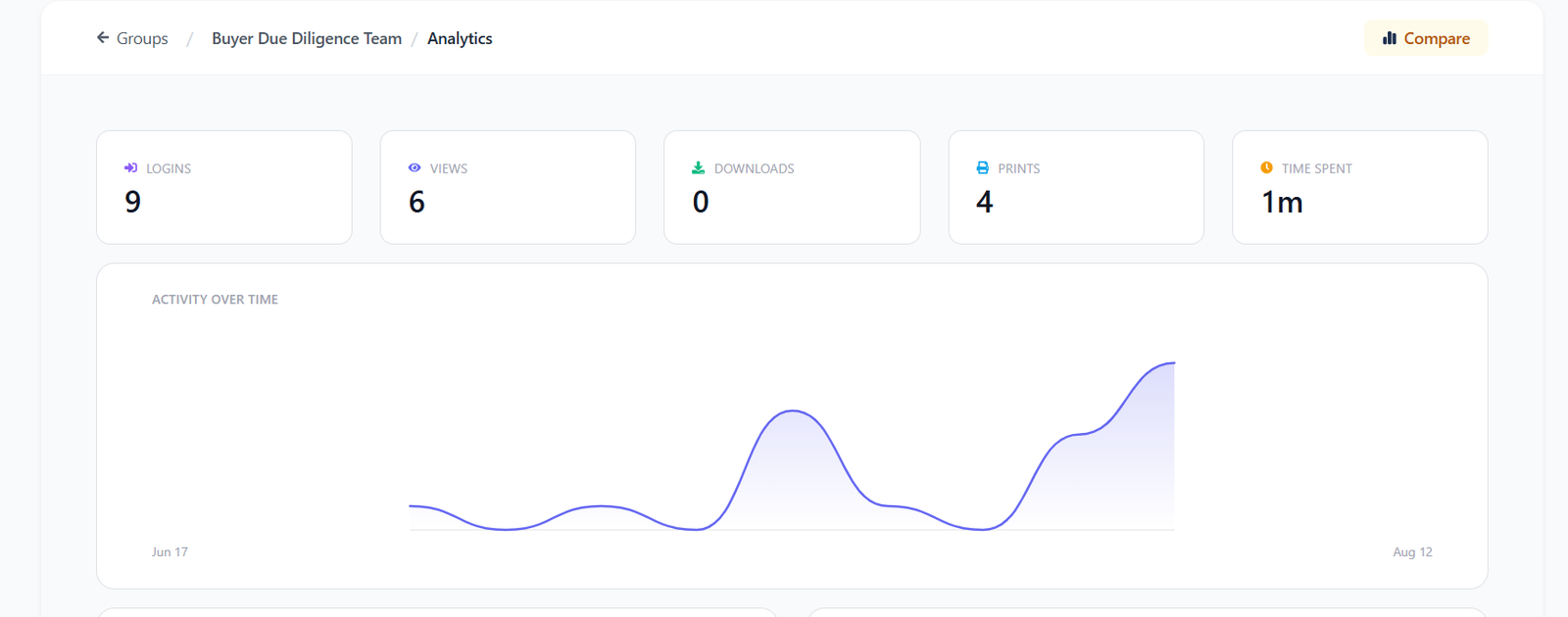
In modern M&A and fundraising, having access to documents is only one part of the process. Deal teams also need to understand what happens after information is shared. Buyers and investors may receive the same financial model, pitch deck, or legal documents, but their level of engagement can be very different.
This is where DeelTrix Analytics and Group Analytics become particularly valuable. Instead of reviewing activity one user at a time, administrators can compare entire stakeholder groups and identify differences in engagement. For teams evaluating platforms such as iDeals, this group-level intelligence can be an important consideration.
Why Group Analytics Matters
A typical transaction may involve multiple stakeholder groups:
- Buyer A
- Buyer B
- Buyer C
- Existing investors
- New investors
- Legal advisors
- Financial advisors
- Internal management
Each group can interact with the data room differently. Looking only at overall activity may hide these differences.
DeelTrix Group Analytics helps administrators compare group activity and understand how different stakeholders are progressing through the transaction.
| Group Analytics Insight | How It Helps M&A | How It Helps Fundraising |
|---|---|---|
| Document engagement | Identify active buyers | Identify engaged investors |
| Group activity | Compare potential acquirers | Compare investor groups |
| Download activity | Understand deeper diligence activity | Identify investors reviewing materials offline |
| Frequently viewed documents | Understand buyer priorities | Understand investor interests |
| Activity trends | Track changing buyer engagement | Monitor investor momentum |
| Group comparison | Prioritize buyer follow-ups | Prioritize investor conversations |
Real M&A Example
Imagine an investment banker managing a sell-side transaction with three potential buyers.
All three buyers have access to the same core financial and commercial documents. However, their behavior differs:
- Buyer A: Frequently reviews financial models and forecasts.
- Buyer B: Focuses heavily on customer contracts.
- Buyer C: Has limited activity across the data room.
With DeelTrix, the advisor can compare these buyer groups through Group Analytics rather than manually compiling individual activity.
This does not automatically prove which buyer will submit the strongest offer. However, it gives the advisor another useful signal when deciding where to focus conversations and follow-up.
For teams accustomed to iDeals, this type of group-level visibility can represent a meaningful difference in how transaction data is interpreted.
Fundraising Example
The same principle applies to fundraising.
Suppose a startup has 50 prospective investors divided into three groups:
| Investor Group | Investors | Current Stage |
|---|---|---|
| Initial Interest | 25 | Reviewing pitch materials |
| Active Discussions | 15 | Evaluating financials |
| Due Diligence | 10 | Reviewing detailed documents |
The founder can use DeelTrix to monitor how these groups engage with the data room.
If the Active Discussions group suddenly increases activity around financial models and market documents, the fundraising team may decide that those investors deserve more immediate follow-up.
If another group remains inactive after receiving several updates, the team may choose to prioritize other conversations.
Again, analytics should be treated as an additional decision signal, not a guarantee of investor intent.
From Activity Tracking to Deal Intelligence
Basic VDR reporting can answer questions such as:
- Who logged in?
- Which document was opened?
- When did the activity occur?
DeelTrix aims to take this further by helping teams ask:
- Which group is most engaged?
- How does Buyer A compare with Buyer B?
- Which investor group is becoming more active?
- Which documents are attracting the most attention?
- Is engagement increasing or declining?
- Where should the team prioritize follow-up?
This distinction matters when comparing iDeals with modern transaction platforms.
Why Group Comparison Is a Must-Have
For complex M&A and fundraising transactions, group-level analytics can reduce the amount of manual interpretation required from deal teams.
The combination of Data Room Groups + Group Analytics allows administrators to connect access management with engagement intelligence.
For example:
Create Group → Assign Permissions → Share Documents → Monitor Engagement → Compare Groups → Prioritize Follow-Up
This creates a continuous transaction workflow rather than treating analytics as a report generated only after the activity has occurred.
Teams comparing iDeals should therefore consider whether analytics can be used actively during the transaction rather than simply for historical reporting.
Why DeelTrix Adds More Value
DeelTrix combines:
- Real-time Analytics
- Group Analytics
- Data Room Groups
- Granular permissions
- Document engagement
- Q&A Management
- Notify
- Custom Watermarking
- NDA gating
- Audit Export
This allows administrators to connect who has access with how those groups are engaging.
For an M&A advisor, this can help compare competing buyers. For a founder, it can help prioritize investors. For a fundraising advisor, it can provide a clearer view of which investor groups are progressing.
When comparing iDeals, the question should therefore extend beyond whether the platform can securely share documents. Teams should ask whether the platform can help them interpret stakeholder behavior and turn that information into actionable next steps.
Ultimately, iDeals can provide a foundation for secure deal management, but modern transactions increasingly require more than document access and basic reporting. DeelTrix’s Groups and Group Analytics provide a way to compare different stakeholder groups, understand engagement patterns, and support more informed follow-up throughout M&A and fundraising.
That makes group-level analytics not just a useful extra, but an increasingly important capability for teams that want their data room to actively contribute to deal execution and investor engagement.
Final Verdict: Which VDR Should You Choose?
Both iDeals and DeelTrix are capable VDR solutions. If you are running a small one-off process with limited stakeholders, iDeals might be sufficient. However, if you care about investor engagement, fundraising speed, and a seamless duedilligence experience, DeelTrix is the clear winner.
Its combination of advanced analytics and data, easy presentation share features, and streamlined workflow for mergers and acquisitions makes it a future-proof choice for dealmakers.
Key Takeaways
- iDeals is a strong contender but lacks advanced collaboration and engagement tracking.
- DeelTrix was built for deal teams who want to share files, track investor behavior, and close faster.
- The difference shows up during M&A and fundraising processes, where DeelTrix’s analytics and data give you a strategic edge.
- For companies running multiple duedilligence cycles a year, DeelTrix saves time, reduces errors, and improves deal outcomes.
Frequently Asked Questions About DeelTrix and VDRs
Q1: Is DeelTrix more affordable than iDeals?
DeelTrix offers a straightforward subscription model with plans starting at $79/month. Pricing should be compared based on included features, storage, users, data rooms, and transaction requirements rather than assuming a particular pricing structure for iDeals.
Q2: Can I migrate from iDeals to DeelTrix easily?
Yes. DeelTrix can support onboarding and migration planning to help teams move documents, organize users, configure permissions, and establish the new data room structure.
Q3: Is DeelTrix suitable for both fundraising and M&A?
Yes. DeelTrix supports M&A, fundraising, due diligence, investor communications, and other confidential transactions from one platform.
Q4: Does DeelTrix offer analytics?
Yes. DeelTrix provides Analytics and Group Analytics that help administrators understand document engagement, compare stakeholder groups, and identify activity patterns.
Q5: Can I present pitch decks directly in DeelTrix?
Yes. DeelTrix supports presentation sharing workflows that allow teams to securely distribute pitch materials while monitoring engagement.
Q6: What is a virtual data room?
A virtual data room is a secure online environment for storing, organizing, and sharing confidential information with authorized participants. It is commonly used for M&A, fundraising, due diligence, and other sensitive business processes.
Q7: What are data rooms used for?
Data rooms are used for M&A, fundraising, due diligence, investment banking, audits, legal reviews, and strategic transactions. Watch this video to explore why data rooms are crucial
Q8: Is DeelTrix secure?
Yes. DeelTrix is ISO certified and gives organizations the option to select a preferred data center location, helping address applicable data residency mandates. For information about ISO 27001, visit the official ISO 27001 standard.
Q9: What makes DeelTrix an ideal VDR for M&A?
DeelTrix combines granular permissions, analytics, Data Room Groups, Q&A Management, watermarking, NDA gating, notifications, and audit exports, making it an ideal VDR option for teams managing complex transactions.
Q10: Can DeelTrix manage multiple M&A transactions?
Yes. Teams can create separate data rooms for different transactions, keeping documents, users, permissions, questions, and activity separate between projects.
Q11: Does DeelTrix support granular document permissions?
Yes. Administrators can control access at the folder and document level, allowing different stakeholders to receive different information.
Q12: Can administrators control viewing, printing, and downloading?
Yes. DeelTrix supports configurable View Only, Print, and Download permissions. This gives administrators greater control over how sensitive transaction information is consumed.
Q13: Can printed documents contain watermarks?
Yes. When watermarking is enabled, approved printed documents can contain configured watermark information, helping reinforce confidentiality outside the digital environment.
Q14: Does DeelTrix support custom watermarking?
Yes. Custom watermarking provides an additional confidentiality control for sensitive financial, legal, commercial, and investor documents.
Q15: What is NDA gating?
NDA gating can require users to acknowledge confidentiality terms before receiving access to protected information. This can be useful when sharing sensitive materials with external buyers or investors.
Q16: What are Data Room Groups?
Data Room Groups allow administrators to organize users into groups based on buyer, investor, advisor, role, or transaction stage. This can make permission management significantly easier.
Q17: How do Groups make M&A transactions more efficient?
Instead of changing permissions individually, administrators can establish group-based access and move users between groups as their transaction requirements change.
Q18: What is Group Analytics?
Group Analytics helps administrators compare activity between different stakeholder groups. For example, an advisor can compare Buyer A, Buyer B, and Buyer C to understand relative document engagement.
Q19: Why is Group Analytics useful for fundraising?
A fundraising team can create groups such as Initial Interest, Active Evaluation, Due Diligence, and Lead Investors, then compare engagement across those stages.
Q20: Can an ideal VDR help identify investor engagement?
A capable VDR can provide useful engagement information. DeelTrix takes this further with analytics that can help teams understand document activity and prioritize investor follow-ups.
Q21: Does DeelTrix provide Q&A Management?
Yes. DeelTrix Q&A Management keeps questions and responses organized within the transaction environment, helping reduce scattered email conversations.
Q22: Can administrators notify users about document updates?
Yes. DeelTrix Notify allows administrators to broadcast updates and admin notes to selected users or groups.
Q23: Can notifications reference specific documents?
Yes. Administrators can reference the relevant document in an update so recipients can immediately understand what has changed.
Q24: Why is Notify useful during due diligence?
Documents frequently change during due diligence. Notify helps administrators quickly communicate updates to the appropriate stakeholder groups without creating separate communication chains.
Q25: Does DeelTrix provide audit exports?
Yes. Audit Export allows teams to retain relevant transaction activity for reporting, oversight, and transaction documentation.
Q26: Can DeelTrix support team collaboration?
Yes. DeelTrix provides a centralized environment for internal teams to coordinate documents, users, Q&A, notifications, and transaction activity.
Q27: What storage locations does DeelTrix provide?
DeelTrix provides storage location choices including North America, APAC, and Europe, giving organizations greater flexibility around regional data residency requirements.
Q28: Is iDeals suitable for M&A transactions?
iDeals is an established VDR option for transaction workflows. Businesses should compare its current capabilities, pricing, security requirements, and support against alternatives such as DeelTrix.
Q29: How does DeelTrix compare with an ideal VDR?
DeelTrix combines secure document management with Groups, Group Analytics, Q&A, notifications, granular permissions, and collaboration, giving teams a broader transaction-management workflow.
Q30: Can DeelTrix be used by investment banks?
Yes. Investment banking teams can use DeelTrix to manage sell-side and buy-side processes, organize buyer groups, control confidential information, and monitor engagement.
Q31: Can startups use DeelTrix for fundraising?
Yes. Startups can use DeelTrix to share pitch decks, financial models, business plans, legal documents, and other confidential information with investors.
Q32: How can DeelTrix help founders prioritize investors?
Analytics can show which investors are actively engaging with shared materials. Founders can combine these signals with meetings, conversations, and other fundraising information when prioritizing follow-ups.
Q33: Does an ideal VDR need analytics?
Modern deal teams increasingly expect analytics because secure sharing alone does not explain how stakeholders are engaging with the information. DeelTrix provides both document and group-level insights.
Q34: Can DeelTrix compare different buyer groups?
Yes. Group Analytics allows administrators to compare activity between groups, providing additional visibility into buyer engagement during competitive M&A processes.
Q35: Can DeelTrix track document engagement?
Yes. DeelTrix Analytics provides visibility into document activity and engagement, helping teams identify which transaction materials are receiving attention.
Q36: Can DeelTrix restrict highly sensitive documents?
Yes. Administrators can use granular permissions and View Only controls to limit access to sensitive documents and prevent unnecessary downloads.
Q37: Can users print documents without downloading them?
Permissions can be configured separately for viewing, printing, and downloading. This allows teams to create workflows where physical review is permitted without automatically granting download access.
Q38: How does watermarking help M&A teams?
Watermarking reinforces confidentiality and can help identify transaction documents when they are printed or shared within an authorized workflow.
Q39: Can DeelTrix manage multiple investor groups?
Yes. Investors can be organized into groups based on stage, organization, access requirements, or other fundraising criteria.
Q40: Does DeelTrix support due diligence questions?
Yes. Q&A Management provides a centralized location for managing questions, responses, and outstanding requests during diligence.
Q41: How can a VDR reduce M&A administration?
A VDR can centralize document access, stakeholder management, questions, activity tracking, and communication. DeelTrix further reduces administration through Data Room Groups and group-based permissions.
Q42: What should businesses consider when selecting an ideal VDR?
Businesses should evaluate:
- Security
- Granular permissions
- Analytics
- Q&A
- User management
- Data residency
- Collaboration
- Pricing
- Scalability
- Ease of administration
Q43: Can DeelTrix help manage competitive M&A auctions?
Yes. Separate buyer groups can receive appropriate document permissions, while Group Analytics can help advisors compare engagement across potential acquirers.
Q44: Can DeelTrix support sell-side transactions?
Yes. Sellers and their advisors can organize confidential information, establish buyer permissions, respond to questions, communicate updates, and monitor engagement.
Q45: Can DeelTrix support buy-side diligence?
Yes. Buyers can use the platform to review transaction materials, coordinate diligence, submit questions, and collaborate with their internal and external advisors.
Q46: How does DeelTrix improve fundraising data rooms?
DeelTrix combines secure sharing with presentation engagement, Analytics, Data Room Groups, Q&A, notifications, and granular permissions, helping fundraising teams manage the investor journey more effectively.
Q47: What makes DeelTrix an ideal VDR alternative?
DeelTrix provides a combination of security, flexible access, stakeholder Groups, engagement analytics, Q&A, notifications, watermarking, NDA gating, audit exports, and regional storage.
Q48: Can DeelTrix help organizations with data residency requirements?
Yes. Organizations can select among available storage locations such as North America, APAC, and Europe, depending on their applicable requirements and DeelTrix’s available configuration.
Q49: Is DeelTrix better than iDeals for every business?
Not necessarily. The right platform depends on the organization’s requirements, transaction type, security needs, budget, and workflow. Companies should compare current capabilities and total value before making a decision.
Q50: Why should businesses consider DeelTrix?
DeelTrix brings together secure sharing, granular access controls, Analytics, Group Analytics, Data Room Groups, Q&A Management, Notify, watermarking, NDA gating, audit exports, collaboration, and regional storage.
For teams looking for an ideal VDR experience, the key advantage is having these capabilities connected within one transaction environment rather than relying on multiple disconnected tools.
Share investor decks securely with live updates, page analytics, and instant revocation controls.
Organize financials, contracts, and compliance docs in one secure room with audit trails.
Control sensitive contracts and regulatory files with watermarking and access restrictions.
Send proposals with engagement signals and track which sections prospects value most.
Distribute reports with visibility into reader activity and keep conversations in-platform.