Document Management Platform: Outlook
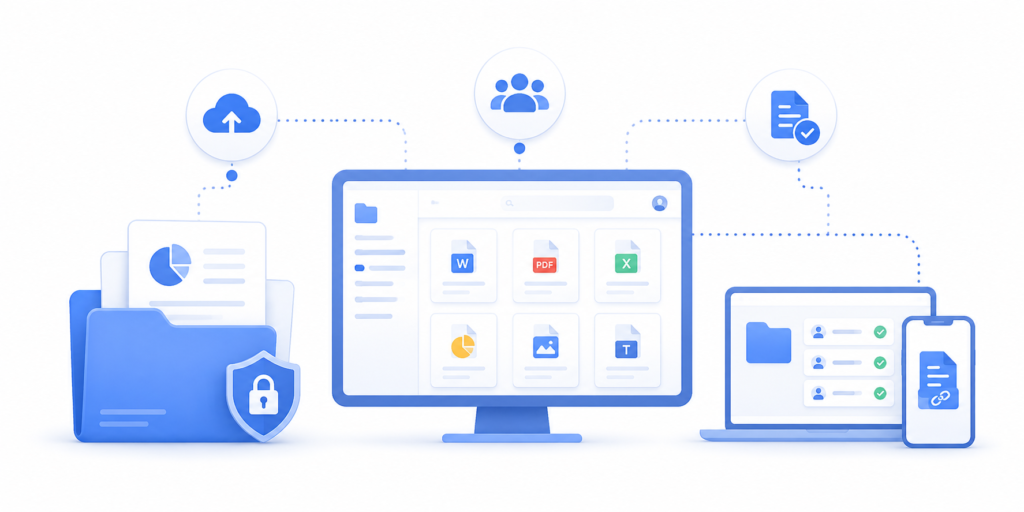
Every organization creates, receives, and shares thousands of files every year. Contracts, proposals, financial reports, compliance documents, HR records, investor presentations, and confidential business data all need to be stored securely while remaining easy to access. Managing these files manually often leads to version confusion, security risks, missing documents, and wasted employee time.
A modern document management platform solves these challenges by centralizing documents, controlling access, tracking activity, and simplifying collaboration across departments. Instead of relying on scattered folders, email attachments, or multiple cloud storage services, businesses can manage every important document from one secure workspace. This not only improves productivity but also strengthens compliance and protects sensitive information throughout the organization.
Whether you’re a startup preparing for fundraising, a legal firm handling confidential cases, or an enterprise managing thousands of files daily, investing in the right platform can transform the way your business operates.
What is a document management platform?
A document management platform is software that helps businesses securely organize, store, search, manage, share, and monitor digital documents from one centralized location. Unlike traditional file storage systems, it provides advanced features such as permission management, audit trails, version history, workflow automation, and secure external sharing.
Organizations no longer need to wonder who edited a file, whether someone downloaded confidential information, or which version is the latest. Every action is recorded, making collaboration transparent and significantly reducing operational risks.
Modern businesses also expect integrations with cloud storage, email services, CRM software, and productivity applications, allowing employees to continue working without changing their existing workflows.
Why businesses are moving away from traditional file storage
Many organizations still depend on shared drives, local servers, or email attachments to exchange files. While these methods may work initially, they become increasingly difficult to manage as teams grow and projects become more complex.
Some of the biggest challenges include:
- Multiple versions of the same document
- Difficulty locating important files
- Limited access controls
- Weak audit capabilities
- Accidental deletion of data
- Compliance risks
- Poor collaboration across departments
A centralized platform eliminates these issues by providing structured storage, intelligent search capabilities, and complete visibility into every document’s lifecycle.
Core features every business should look for
Choosing software involves more than comparing storage limits. The right solution should improve security, collaboration, and operational efficiency simultaneously.
Secure Document Storage
Every file should be encrypted both during transfer and while stored. Granular permissions ensure employees only access information relevant to their responsibilities.
Version Control
Instead of creating multiple copies named “Final”, “Final 2”, or “Latest Final”, version history maintains every update automatically while preserving previous revisions.
Permission Management
Role-based permissions prevent unauthorized viewing, downloading, editing, or sharing of confidential documents.
Audit Trails
Every activity—including uploads, downloads, comments, edits, and shares—is recorded for compliance and accountability.
Advanced Search
Metadata, OCR indexing, tags, and intelligent filtering allow users to locate documents within seconds instead of manually browsing folders.
Collaboration Tools
Internal comments, notifications, approvals, and review workflows eliminate unnecessary email chains.
Comparison of traditional storage vs modern document management
| Feature | Traditional File Storage | Modern Business Platform |
|---|---|---|
| File Search | Manual folders | Instant intelligent search |
| Version Control | Multiple copies | Automatic version history |
| Permissions | Basic | Granular user access |
| Audit Logs | Limited | Complete activity tracking |
| External Sharing | Email attachments | Secure share links |
| Compliance | Difficult | Built-in reporting |
| Collaboration | Slow | Real-time |
How cloud technology improves document management
Today’s organizations increasingly rely on cloud document management because employees need secure access from anywhere. Hybrid work environments, remote teams, consultants, and external partners all require reliable document availability without compromising security.
Cloud-based solutions provide automatic backups, disaster recovery, high availability, and simplified maintenance. Instead of investing heavily in local infrastructure, businesses can scale storage and users as needed while reducing IT costs.
Another advantage is continuous software updates. Organizations always have access to the latest security improvements and productivity features without complicated upgrade projects.
Supporting compliance and governance
Many industries must comply with strict regulations regarding document retention, privacy, and audit requirements. Healthcare, legal services, finance, manufacturing, and investment firms all face growing compliance responsibilities.
A comprehensive document control system helps organizations maintain document integrity by enforcing approval workflows, recording modifications, and preventing unauthorized changes.
Automatic retention policies, approval processes, and activity logs also simplify regulatory audits, making compliance significantly easier than manual documentation methods.
Managing legal documents efficiently
Law firms and corporate legal departments process thousands of contracts, agreements, litigation files, intellectual property records, and client documents.
A dedicated legal document management system helps legal professionals organize case files securely while maintaining confidentiality and detailed audit histories.
Features such as permission-based access, version tracking, secure client sharing, and advanced document search reduce administrative workload and allow lawyers to focus more on legal work rather than file management.
Because legal matters often involve multiple stakeholders, centralized collaboration also minimizes communication delays and improves overall efficiency.
Electronic document management for modern businesses
Paper-based workflows continue to disappear as organizations digitize operations.
An electronic document management system converts paper records into searchable digital assets while supporting approvals, electronic collaboration, and long-term archival.
Benefits include:
- Reduced paper storage costs
- Faster document retrieval
- Improved employee productivity
- Better disaster recovery
- Enhanced document security
- Easier compliance reporting
- Lower operational expenses
Digital workflows also eliminate unnecessary printing, contributing to more sustainable business operations.
Supporting mergers, acquisitions, and fundraising
Organizations involved in fundraising, acquisitions, investment banking, or corporate transactions require highly secure environments for confidential information sharing.
A due diligence data room enables companies to organize sensitive financial records, contracts, legal documents, intellectual property, customer information, and operational reports before sharing them with investors or buyers.
Unlike generic file-sharing tools, specialized environments provide watermarking, visitor permissions, download restrictions, activity tracking, and detailed analytics showing how prospective investors interact with documents.
These insights help management teams understand investor interest while maintaining complete confidentiality throughout the transaction.
Why virtual data rooms matter
As businesses increasingly collaborate across borders, virtual data room software has become essential for secure document exchange.
Instead of sending large email attachments or providing unrestricted cloud folders, organizations can securely share documents with investors, auditors, legal advisors, consultants, and buyers.
Key advantages include:
- Dynamic watermarking
- Download restrictions
- Expiring links
- Activity monitoring
- Multi-factor authentication
- Detailed reporting
- Secure document indexing
These capabilities reduce security risks while giving administrators full control over sensitive business information.
Why DeelTrix stands out
DeelTrix combines secure document storage with advanced collaboration, making it suitable for startups, investment firms, legal teams, and growing enterprises.
The platform offers:
- Secure document sharing
- Unlimited virtual data rooms
- Activity tracking
- Visitor analytics
- Version management
- User permissions
- Review workflows
- Secure external links
- Organized file structure
- Fast document search
Rather than juggling multiple software tools, businesses can centralize document management, fundraising workflows, investor communication, and secure collaboration within one platform.
For organizations involved in fundraising or M&A, DeelTrix also streamlines document reviews by allowing teams to monitor engagement, manage permissions, and maintain a complete audit history.
Benefits businesses experience after implementation
Organizations adopting modern document solutions typically notice improvements across multiple operational areas.
Higher productivity comes from eliminating time spent searching for files.
Better collaboration results from centralized documents instead of scattered email attachments.
Stronger security reduces the likelihood of accidental exposure or unauthorized downloads.
Simplified compliance minimizes regulatory risks through automated audit logs and approval workflows.
Lower IT costs become possible through scalable cloud infrastructure instead of expensive on-premise storage.
Improved client confidence develops because sensitive information is shared professionally through secure portals rather than unsecured methods.
Choosing the right solution
Selecting software should begin with evaluating business requirements rather than simply comparing prices.
Consider factors such as:
- Security certifications
- Permission flexibility
- Version control
- Audit capabilities
- Scalability
- Search performance
- External sharing
- Integration support
- Compliance features
- Customer support
Organizations expecting growth should also ensure the platform can support increasing users, larger storage requirements, and evolving security needs without requiring major infrastructure changes.
The ideal solution balances usability with enterprise-grade security, allowing employees to work efficiently while protecting valuable business information.
Conclusion
Managing documents efficiently has become a competitive advantage rather than simply an administrative task. Organizations that continue relying on outdated storage methods often struggle with collaboration, security, compliance, and operational efficiency.
Modern businesses require centralized management, secure sharing, intelligent search, comprehensive audit trails, and scalable cloud infrastructure. Whether handling legal contracts, investor documentation, HR records, financial reports, or confidential company information, the right platform improves productivity while reducing risk.
DeelTrix provides businesses with an efficient solution that combines secure document management, collaboration, activity tracking, and virtual data room capabilities into one streamlined platform. As organizations continue embracing digital transformation, investing in reliable document management software becomes an essential step toward long-term operational success.
FAQ’s
What is the difference between a file storage system and a document management platform?
A file storage system mainly stores files, while a document management platform provides advanced capabilities such as version control, permissions, audit trails, workflow automation, secure sharing, and document tracking.
Can an electronic document management system replace paper records?
Yes. An electronic document management system digitizes paper documents, making them searchable, secure, and much easier to manage while reducing storage costs and improving operational efficiency.
Why do legal firms need a legal document management system?
A legal document management system helps law firms securely organize contracts, case files, legal correspondence, and confidential client records while maintaining complete audit trails and access controls.
What are the advantages of cloud document management?
Cloud document management enables secure remote access, automatic backups, disaster recovery, simplified collaboration, lower infrastructure costs, and easy scalability for growing businesses.
How does a document control system improve compliance?
A document control system records document revisions, approval histories, user activity, and retention policies, making regulatory compliance and audits significantly easier.
When should businesses use a due diligence data room?
A due diligence data room is ideal during fundraising, mergers, acquisitions, audits, and investor reviews where confidential documents must be securely shared with external stakeholders.
What makes virtual data room software more secure than email?
Virtual data room software includes advanced security features like watermarking, permission-based access, download restrictions, expiring links, audit logs, and visitor analytics that traditional email cannot provide.
Why should businesses choose DeelTrix?
DeelTrix combines secure document storage, collaboration, activity tracking, investor-ready data rooms, permission management, and workflow capabilities into one easy-to-use platform, making it an excellent choice for modern organizations with ISO certified infrastructure.