Document Control System: Why business choose a Virtual Data Room?
Managing important business documents becomes increasingly difficult as organizations grow, work with external stakeholders, and participate in sensitive transactions. Financial records, contracts, investor materials, legal documents, due diligence files, intellectual property, and confidential business information all require more than simple cloud storage. A strong Document Control System helps businesses organize information while maintaining visibility, security, permissions, and accountability throughout the document lifecycle.
For investment banks, advisory firms, startups, corporations, legal teams, and companies involved in mergers and acquisitions, a Virtual Data Room (VDR) provides a specialized environment for handling sensitive information. Instead of relying on email attachments and ordinary file-sharing links, teams can use a centralized platform designed around controlled access and secure collaboration. DeelTrix combines these capabilities with analytics and transaction-focused workflows, making it a strong VDR option for organizations that need greater control over business information.
What Is a Document Control System?
A Document Control System is a structured approach to managing documents from creation and organization through sharing, review, updating, and eventual archiving. The objective is not simply to store files, but to make sure the right people can access the right information while administrators maintain control over how documents are handled.
In a transaction environment, document control becomes even more important because multiple stakeholders may need access to different information. Investors, buyers, lawyers, financial advisors, management teams, and consultants may all participate in the same process. A VDR creates a secure environment where these participants can review approved information without receiving unrestricted access to the entire document library.
Why Traditional File Sharing Creates Problems
Traditional file-sharing tools can work well for everyday collaboration, but they are not always designed for high-stakes transactions. Administrators may have limited visibility into document activity, permission structures can become difficult to maintain, and confidential information may be distributed through multiple links or email attachments.
A dedicated Document Control System provides a more organized approach by bringing document storage, access management, monitoring, and collaboration into one controlled workspace. This reduces administrative complexity and gives deal teams greater confidence when sharing sensitive information externally.
Top 5 Reasons to Use a VDR
1. Stronger Security and Access Control
Security is one of the primary reasons organizations move from ordinary file sharing to a VDR. During fundraising, M&A, due diligence, audits, or strategic partnerships, documents can contain highly sensitive information that should only be available to authorized users.
A VDR can provide controls for viewing, downloading, printing, and sharing documents. Administrators can also manage permissions according to users, groups, folders, or individual files. This makes the Document Control System more suitable for situations where confidentiality and accountability are essential.
Control Access at the Right Level
Not every stakeholder requires identical permissions. A potential buyer might need access to financial information, while legal counsel may require access to contracts and corporate records. Internal management may need broader access than an external investor.
With granular permissions, administrators can create access structures based on actual transaction requirements. This reduces the possibility of accidentally exposing confidential documents to the wrong audience.
2. Simplified Due Diligence
Due diligence often involves reviewing hundreds or thousands of documents across multiple categories. Without a structured environment, teams can spend significant time answering file requests, locating missing documents, checking versions, and managing access.
A VDR provides a centralized workspace where authorized participants can access organized information. This allows the deal team to establish folders, upload approved materials, and manage access before external reviewers begin their work.
The result is a more efficient Document Control System that reduces repetitive administrative tasks and makes the review process easier for everyone involved.
Build a Professional Transaction Workspace
A well-structured data room can also improve the experience of investors, buyers, and advisors. Instead of receiving scattered attachments or multiple file-sharing links, stakeholders can access a single organized environment.
Teams can arrange information into categories such as Corporate, Financial, Legal, Tax, Commercial, HR, Intellectual Property, and Operations. This structure helps reviewers find relevant information faster while allowing administrators to maintain control over the entire workspace.
3. Better Document Activity Visibility
Knowing who has access to a file is useful, but understanding what users actually do with that information can be even more valuable. During an M&A transaction or fundraising process, activity data can help teams understand stakeholder engagement.
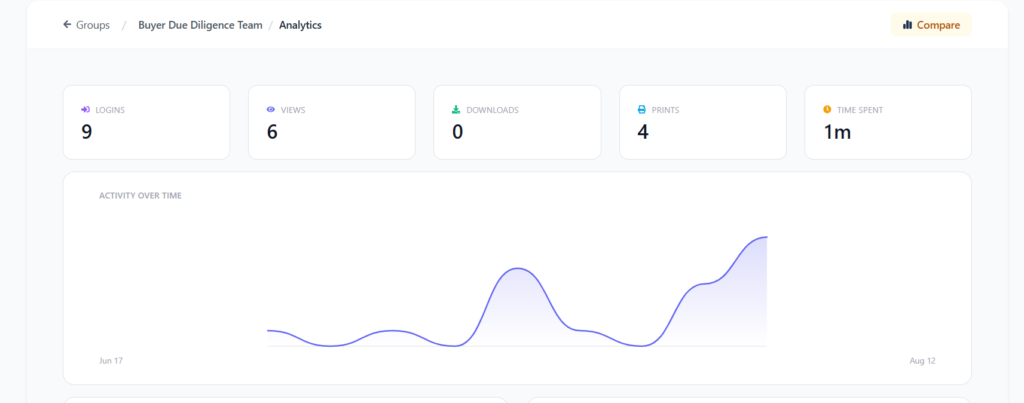
A modern Document Control System can provide information about document views, downloads, user activity, and engagement patterns. This creates a clearer picture of how external stakeholders interact with sensitive materials.
Turn Engagement Into Useful Intelligence
For example, if a prospective investor spends significant time reviewing financial projections but has not viewed the legal documents, the deal team may use that information when deciding what to discuss during a follow-up meeting.
Similarly, if a buyer repeatedly accesses a particular folder, advisors can anticipate questions or prepare additional information around that area. Analytics therefore transform document activity from passive records into useful transaction intelligence.
4. More Efficient Collaboration With Multiple Stakeholders
Transactions rarely involve only two parties. A single deal can include management teams, investors, investment bankers, lawyers, accountants, consultants, and other advisors.
Managing access individually can become increasingly complicated as the number of participants grows. A VDR provides a centralized environment where different stakeholder groups can receive appropriate access without creating separate document repositories.
A reliable Document Control System can therefore support collaboration while preserving separation between internal and external information. Administrators can update documents centrally and make approved information available to authorized users without repeatedly sending new attachments.
Group-Based Access Management
Group permissions can be particularly useful when several users have similar responsibilities. Instead of configuring every person individually, administrators can organize stakeholders according to their role or organization.
This approach can simplify access management as a transaction progresses and new participants are added. It also makes permission structures easier to understand and maintain.
5. Greater Accountability and Audit Readiness
Sensitive transactions require more than secure storage. Teams often need to demonstrate who accessed information, when documents were reviewed, and how information was shared.
A VDR can maintain activity records that provide greater transparency throughout the document lifecycle. These records can be valuable when reviewing transaction activity, investigating access questions, or maintaining an audit trail.
For organizations that regularly handle confidential information, a Document Control System with detailed activity tracking provides an additional layer of operational accountability.
Document Control System vs. Traditional File Sharing
| Capability | Traditional File Sharing | VDR – DeelTrix |
|---|---|---|
| Basic document storage | Yes | Yes |
| Folder organization | Yes | Yes |
| Granular permissions | Limited | Advanced |
| Transaction-specific access | Limited | Yes |
| User activity tracking | Limited | Yes |
| Document engagement analytics | Limited | Yes |
| Download controls | Basic | Advanced |
| Print controls | Limited | Advanced |
| Audit trails | Limited | Yes |
| Group-based permissions | Limited | Yes |
| Due diligence workflows | No | Yes |
| Secure external collaboration | Basic | Advanced |
The comparison demonstrates why a specialized platform can be more appropriate when documents are being shared as part of a transaction. Basic storage focuses primarily on accessibility, while a VDR combines accessibility with security, control, monitoring, and collaboration.
How DeelTrix Improves Document Control
DeelTrix is designed to bring document management, secure sharing, access control, and engagement intelligence together within a VDR environment. This makes it useful for investment banking teams, M&A advisors, capital-raising teams, startups, and businesses handling sensitive external document sharing.
Secure Data Rooms for Sensitive Information
DeelTrix allows teams to create dedicated data rooms where important transaction documents can be organized and shared with approved stakeholders. This provides a more professional alternative to distributing confidential files through email attachments.
Administrators can control access while maintaining visibility into stakeholder activity. This combination is especially valuable when the information being shared could affect negotiations, investment decisions, or transaction outcomes.
Granular Access for Different Users
Different stakeholders often require different permissions. DeelTrix supports more detailed access management so administrators can determine which users should have access to specific documents and folders.
This makes the Document Control System more adaptable to complex transaction structures where investors, advisors, buyers, management teams, and legal representatives may all require different levels of access.
Analytics for Investor and Buyer Engagement
DeelTrix also provides document engagement insights that can help teams understand how stakeholders interact with shared materials. Instead of simply knowing that documents were uploaded, teams can gain visibility into activity surrounding those documents.
This can support better follow-up during fundraising and M&A. Deal teams can identify highly viewed materials, understand engagement patterns, and use those insights when preparing conversations with potential investors or buyers.
A VDR Built Around Deal Workflows
A major advantage of DeelTrix is that it is positioned around business transactions rather than generic file storage. The platform can support workflows involving fundraising, due diligence, M&A, advisory engagements, and other processes where secure document sharing is critical.
By combining access controls, document organization, analytics, and collaboration capabilities, DeelTrix helps create a more connected environment for transaction teams.
When Should a Business Use a VDR?
A business should consider a VDR whenever confidential documents need to be shared with external stakeholders while maintaining control over who can access, view, download, print, or interact with those files. Unlike ordinary cloud storage, a VDR is designed for situations where document security, controlled access, collaboration, and activity visibility are important. This makes it particularly useful for companies involved in M&A, fundraising, due diligence, audits, legal reviews, investor communications, strategic partnerships, and other sensitive business activities.
The earlier a company establishes a structured Document Control System, the easier it becomes to prepare information before a transaction becomes time-sensitive. Instead of searching through emails, personal drives, and disconnected folders when an investor or buyer requests information, teams can organize documents in advance and establish appropriate permissions. This preparation can significantly reduce delays and make the overall process more professional.
1. During M&A Transactions
M&A transactions are one of the most common situations where businesses need a VDR. Buyers and their advisors may request hundreds or thousands of documents covering financial performance, contracts, employees, intellectual property, customers, operations, tax information, and corporate records.
A VDR gives the seller a centralized environment for organizing and sharing these documents without sending large numbers of attachments through email.
Key benefits include:
- Create dedicated folders for different due diligence categories.
- Give buyers and advisors controlled access to specific information.
- Track document views and downloads.
- Update documents without repeatedly sending new attachments.
- Maintain an activity history of stakeholder interactions.
- Reduce the risk of accidentally sharing confidential information.
A structured Document Control System also makes it easier for the internal deal team to understand which information has already been provided and which documents still need to be prepared.
2. During Fundraising
Fundraising often requires founders to share sensitive business information with potential investors. This can include pitch decks, financial models, cap tables, incorporation documents, customer information, intellectual property records, contracts, and business plans.
Using a VDR gives founders greater control over this information while creating a professional investor experience. Instead of sending different files to every investor, the company can create a centralized workspace and provide appropriate access.
| Fundraising Requirement | How a VDR Helps |
|---|---|
| Pitch deck sharing | Centralized and controlled access |
| Financial model | Restrict access to approved investors |
| Legal documents | Organize information in dedicated folders |
| Investor engagement | Monitor document activity |
| Sensitive information | Apply access restrictions |
| Multiple investors | Manage users independently |
| Updated documents | Replace files without resending links |
A VDR can therefore become an important part of the fundraising process, particularly when multiple investors are reviewing information simultaneously.
3. For Due Diligence
Due diligence can quickly become difficult when information is stored across multiple systems. Legal teams, accountants, investors, buyers, and advisors may all request different documents, sometimes at the same time.
A VDR creates a single source of truth for approved transaction documents. Teams can establish a consistent folder structure and give each stakeholder access based on their role.
A VDR Can Help With:
- Financial due diligence.
- Legal due diligence.
- Commercial due diligence.
- Tax reviews.
- HR and employee documentation.
- Intellectual property reviews.
- Operational assessments.
- Technology and security reviews.
With a properly organized Document Control System, teams can also reduce confusion around document versions and avoid repeatedly searching for files when new requests arrive.
4. For Audits and Legal Reviews
Businesses regularly need to provide sensitive information to auditors, lawyers, consultants, and other professional advisors. Emailing confidential documents or creating unrestricted file-sharing links can create unnecessary security and administrative risks.
A VDR provides a controlled environment where external professionals can access the information they require without receiving unrestricted access to the company’s entire document library.
This can be particularly useful for:
- Financial audits.
- Regulatory reviews.
- Legal investigations.
- Contract reviews.
- Compliance assessments.
- Corporate restructuring.
- Insurance reviews.
The activity history can also provide useful visibility into document access, helping organizations maintain better accountability throughout the review.
5. For Strategic Partnerships
Strategic partnerships can require companies to exchange confidential information before agreements are finalized. Organizations may need to share product information, financial details, technical documentation, market research, contracts, or intellectual property.
A VDR allows businesses to share this information while maintaining control over access. If negotiations change or a partnership does not proceed, administrators can modify or revoke access rather than leaving files permanently available through previously distributed attachments.
6. For Investor and Stakeholder Communications
Companies that regularly communicate with investors, board members, advisors, or strategic stakeholders can also benefit from a VDR. Instead of using multiple channels to distribute sensitive documents, organizations can establish a centralized environment for important information.
This becomes particularly useful when stakeholders need access to recurring materials such as:
- Board presentations.
- Financial reports.
- Investor updates.
- Business plans.
- Performance reports.
- Strategic documents.
- Corporate records.
A consistent Document Control System helps ensure that stakeholders are accessing approved information rather than outdated files saved from previous email exchanges.
When Is the Right Time to Set Up a VDR?
Businesses should ideally set up a VDR before they urgently need one. Waiting until a buyer, investor, or advisor requests hundreds of documents can create unnecessary pressure on the team.
Early preparation allows companies to:
- Audit existing documents.
- Remove duplicate or outdated files.
- Establish logical folders.
- Identify sensitive information.
- Define user permissions.
- Prepare standardized naming conventions.
- Create access groups.
- Upload approved documents.
- Establish a consistent review process.
Why Early Preparation Matters
Imagine a company receives an acquisition offer and has only a few days to prepare its data room. Employees may need to search through years of emails and folders to locate contracts, financial statements, employee records, and other documents.
With a Document Control System already in place, much of this work can be completed before the transaction begins. When the opportunity arrives, the team can focus on the transaction rather than spending valuable time organizing files.
Signs Your Business Needs a VDR
A company should seriously consider adopting a VDR if several of the following situations apply:
- Confidential documents are frequently shared with people outside the company.
- Employees regularly send sensitive files through email.
- Multiple investors or buyers are reviewing company information.
- Different stakeholders require different document permissions.
- The business is preparing for an M&A transaction.
- The company is raising capital.
- Legal or financial due diligence is approaching.
- Management struggles to determine who accessed important documents.
- Teams maintain multiple versions of the same document.
- External advisors regularly request large numbers of files.
- There is a need for stronger document activity tracking.
- The company wants a more professional document-sharing experience.
VDR as a Long-Term Document Strategy
A VDR should not necessarily be viewed as a temporary tool used only during a transaction. For organizations that frequently handle confidential information, it can become an important component of their broader Document Control System.
Investment banks can use VDRs across multiple deals. Advisory firms can create dedicated environments for different clients. Startups can prepare investor materials before fundraising begins. Corporations can maintain transaction-ready documentation for future M&A opportunities.
The biggest advantage is preparation. When documents are already organized, permissions are defined, and stakeholders can be managed through a centralized platform, teams can respond much faster when an important business opportunity or review process begins.
Ultimately, a VDR is most valuable when control, confidentiality, collaboration, and visibility matter. Whether the requirement is M&A, fundraising, due diligence, auditing, legal review, or strategic collaboration, establishing a structured environment before information starts moving between multiple parties can make the entire process more secure and efficient.
Prepare Before the Transaction Begins
A strong data room can also improve operational readiness. Teams can identify important documents, remove outdated versions, create appropriate folders, and establish access rules before inviting external participants.
This preparation can reduce delays during diligence and help stakeholders find information more efficiently. It also creates a repeatable process that organizations can use for future transactions.
Why DeelTrix Can Be the Best VDR Tool for Growing Teams
The best VDR tool is not necessarily the platform with the longest feature list. It should be a platform that provides the right balance of security, usability, document control, analytics, and transaction functionality.
DeelTrix focuses on these practical requirements by combining secure data rooms with granular access management and document engagement intelligence. For teams that need to share sensitive information while maintaining visibility into stakeholder activity, this combination can provide meaningful value.
For investment banks and advisory firms, the platform can support multiple transactions and stakeholder groups. For startups, it can provide a professional environment for fundraising and investor document sharing. For corporations, it can support M&A diligence and other confidential business processes.
Conclusion
A modern Document Control System should do much more than store files. It should help organizations control access, protect sensitive information, understand document activity, simplify collaboration, and maintain accountability throughout important business processes.
A VDR addresses these requirements by creating a secure environment specifically designed for sensitive document sharing. It can make due diligence more efficient, improve stakeholder collaboration, provide useful engagement insights, and reduce the risks associated with uncontrolled file distribution.
DeelTrix strengthens this model by combining secure data rooms, granular permissions, analytics, organized document workflows, and transaction-focused functionality. For businesses looking for a VDR that goes beyond basic file storage, DeelTrix offers a comprehensive approach to managing sensitive information.
FAQ’s
What is a Document Control System?
A Document Control System is a structured method for organizing, securing, sharing, tracking, updating, and managing business documents throughout their lifecycle. It helps ensure that authorized users receive the correct information while administrators maintain control over access and document activity.
Why should businesses use a VDR?
Businesses use VDRs when they need to share confidential information with external stakeholders while maintaining stronger security and access controls. VDRs are particularly useful for M&A, fundraising, due diligence, audits, and legal reviews.
How does a VDR improve document security?
A VDR can provide controlled permissions for viewing, downloading, printing, and sharing. It can also maintain activity records so administrators have greater visibility into how sensitive information is accessed.
Is a VDR useful for fundraising?
Yes. Startups and companies raising capital can use a VDR to securely share pitch decks, financial models, cap tables, legal documents, and other investor materials while monitoring engagement.
How does DeelTrix help with due diligence?
DeelTrix provides a centralized environment for organizing transaction documents, managing stakeholder access, monitoring activity, and supporting secure collaboration. This can reduce the administrative workload associated with large diligence processes.
Can DeelTrix control access to individual documents?
Yes. DeelTrix is ISO 27001 certified & provides granular access capabilities that allow administrators to manage permissions around specific information and stakeholder requirements. This can be useful when different participants need access to different parts of a transaction.
Does a VDR track document activity?
Modern VDR platforms can track activities such as views, downloads, and other interactions. These insights can help transaction teams understand stakeholder engagement and make more informed follow-up decisions.
Is DeelTrix suitable for M&A transactions?
Yes. DeelTrix is designed to support transaction-oriented workflows, making it suitable for M&A diligence, advisory engagements, and other processes that require controlled document sharing and stakeholder monitoring.
What makes DeelTrix different from ordinary cloud storage?
Ordinary cloud storage primarily focuses on storing and accessing files. DeelTrix combines secure data rooms with access controls, analytics, stakeholder management, and transaction-focused workflows, providing a more specialized environment for sensitive business processes.
Why is a Document Control System important for growing companies?
As organizations grow, the number of documents, users, and external stakeholders usually increases. A structured approach helps businesses maintain security, reduce document confusion, control permissions, and create greater accountability around sensitive information.